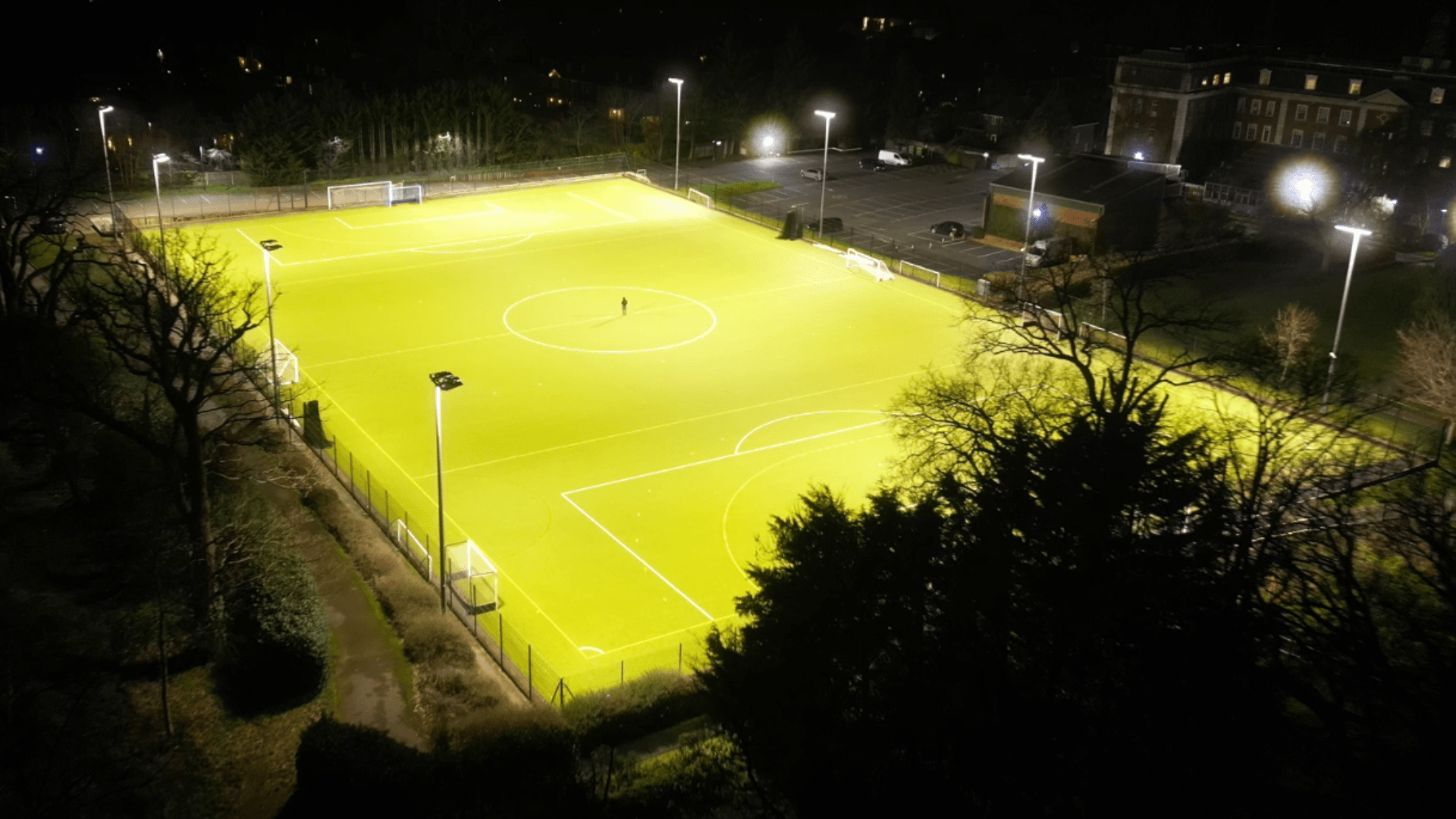
Good sports lighting is about much more than simply making a pitch, court or sports hall bright enough to see.
The quality, consistency and control of the light all affect player performance, safety, spectator experience and, at higher levels of sport, broadcasting requirements.
In the UK, one of the key standards used when designing artificial sports lighting is BS EN 12193:2018 – Light and Lighting: Sports Lighting.
Whether you are planning new sports floodlighting, upgrading an ageing system or checking whether your existing installation still performs as it should, understanding the basic principles behind BS EN 12193 can help you make more informed decisions.
BS EN 12193 is the British and European standard covering artificial lighting for many of the indoor and outdoor sports commonly played across Europe.
It provides requirements and recommendations for the design and assessment of sports lighting installations, including:
The aim is to provide good visual conditions for players, officials and spectators while also considering issues such as visual comfort and obtrusive light.
However, BS EN 12193 should not necessarily be viewed in isolation. Individual sports governing bodies can also specify their own lighting requirements depending on the sport and level of competition.
This is why a professional sports lighting design should always begin by establishing what the facility will be used for now and what it may need to accommodate in the future.
Two sports facilities can appear equally bright to the eye while delivering very different levels of lighting performance.
A successful design must consider not only how much light reaches the playing surface, but how evenly that light is distributed and whether players can comfortably follow fast-moving balls or other competitors without glare, excessive shadowing or distracting bright spots.
Good visibility allows players to react quickly and judge speed, distance and movement accurately.
Poorly distributed lighting, dark areas or excessive glare can make it more difficult to see the playing surface, other players or the ball.
Lighting should be reasonably consistent across the entire playing area.
If one side of a pitch is significantly brighter than another, players continually have to adjust to different lighting conditions as they move around the facility.
The lighting needed for recreational training can be very different from that required for competitive sport.
Clubs considering promotion, league progression or hosting higher-level competitions should therefore consider future requirements before investing in a new system.
Designing only for today's minimum requirement could result in another upgrade being required later.
Lighting also needs to provide good visibility for officials and spectators.
For venues hosting larger competitions or televised events, additional requirements may also apply to ensure suitable visibility for cameras and broadcasting equipment.
BS EN 12193 recognises that not every sports venue needs the same level of lighting.
The required lighting class depends largely on the level and type of sporting activity taking place.
A community training facility, for example, will generally have different requirements from a venue hosting regional, national or international competition.
The principle is important when planning a project because simply asking for "sports floodlighting" or a particular number of floodlights does not establish what the completed installation actually needs to achieve.
Before developing a lighting design, it is important to establish:
For multi-use facilities, such as MUGAs and indoor sports halls, the design may need to accommodate several different activities rather than a single sport.
One of the best-known measurements associated with sports lighting is lux.
Lux measures the amount of light reaching a surface.
When discussing an outdoor pitch, for example, lux readings can be taken across a calculated grid covering the playing area. These readings help establish both the level of illumination and how consistently the area is being lit.
Different sports and levels of competition require different lighting performance.
For example, JHP Electrical has dedicated guidance covering football pitch lighting and lux level requirements, while other sports such as hockey, rugby and tennis have their own requirements.
However, achieving a target average lux level alone does not necessarily mean a lighting system is performing well.
Imagine taking lux readings across a pitch.
Some areas may record very high readings while others are noticeably darker. The overall average could still appear acceptable, but the experience for players could be poor.
This is where uniformity becomes important.
Uniformity looks at how evenly light is distributed across the playing area.
A well-designed system aims to avoid:
Modern LED lighting and careful optical design can provide excellent uniformity, but only when fittings are correctly selected, positioned and aimed.
This is why sports floodlighting design should focus on the performance of the whole installation, rather than simply comparing the wattage or output of individual floodlights.
More light does not automatically mean better lighting.
Poorly positioned or badly aimed high-output luminaires can create glare for players, officials and spectators.
In fast-moving sports, glare can be particularly disruptive. A player looking upwards to follow a high ball, for example, should not be unnecessarily exposed to intense light from a floodlight in their natural line of sight.
Controlling glare requires careful consideration of:
This is one reason specialist lighting design is particularly important for facilities such as tennis courts, football pitches, hockey pitches and rugby pitches.
Each sport has different movements, playing areas and viewing angles that need to be considered.
There is no universal sports floodlighting design that can simply be repeated from one venue to another.
Football lighting must provide good visibility across a relatively large playing area while controlling glare for players looking across or upwards on the pitch.
The required performance also changes considerably depending on whether the ground is used for grassroots training or higher levels of competition.
Read our guide to football pitch lighting and lux level requirements for more information.
Tennis presents different challenges because of the speed and relatively small size of the ball, together with the way players frequently look upwards.
Correct positioning, glare control and consistent illumination across the court are therefore particularly important.
Find out more in our guide to tennis court LED floodlighting.
Hockey involves a small, fast-moving ball travelling close to the playing surface, so good uniformity and visibility are essential.
JHP Electrical provides specialist hockey pitch floodlighting for sports clubs and facilities across the UK.
Large playing areas and varied player movement make appropriate lighting levels and uniformity particularly important for rugby.
Our rugby pitch floodlighting solutions are designed around the requirements of the individual facility.
Clubs can also read our guide on the importance of lux testing for rugby clubs.
Athletics facilities can combine running tracks with several different field events, creating a complex lighting environment.
JHP Electrical provides specialist athletics track floodlighting for training and competition venues.
A MUGA may accommodate football, tennis, basketball, netball and other sports on the same surface.
Lighting therefore needs to be designed around the different activities the facility is expected to support.
Our MUGA floodlighting solutions take the intended use, surrounding environment and required performance levels into account from the design stage.
Driving ranges introduce another set of challenges. The lighting needs to allow golfers to follow ball flight across a large outfield while also integrating with bay lighting and, increasingly, ball-tracking technologies.
For more information, read our Driving Range Lighting and Ball Tracking Integration Guide.
A lighting installation should not simply be assumed to meet its intended design because the floodlights switch on and the pitch appears bright.
Lux testing provides objective measurements of the lighting performance across the playing area.
Measurements are taken at defined locations to establish whether the installation is delivering the required illuminance and uniformity.
Lux testing can be useful:
Lighting performance can change over time through deterioration, dirt accumulation, damaged equipment, alterations to aiming or changes elsewhere within the installation.
Periodic testing therefore helps facility managers understand how their lighting is actually performing rather than relying purely on visual impressions.
No.
LED technology offers considerable advantages for sports venues, including improved control, instant switching, energy efficiency and long service life.
However, simply replacing existing fittings with LED floodlights does not automatically create a compliant sports lighting installation.
The design still needs to consider:
In some cases, existing columns and electrical infrastructure can be retained. In others, achieving the required performance may require alterations or a more comprehensive redesign.
A survey and professional lighting design should therefore form part of the process before equipment is selected.
Sports lighting does not operate in isolation.
Outdoor venues may be close to residential properties, roads, wildlife habitats or other sensitive areas.
A good floodlighting design should direct light where it is needed while minimising unnecessary spill beyond the playing area.
This can involve careful luminaire selection, shielding, mast positioning, aiming and lighting controls.
Planning requirements may also need to be considered when installing new floodlights or making significant alterations to an existing system.
Addressing these issues during the design stage is considerably easier than trying to correct excessive glare or light spill after installation.
Lighting performance is only one part of delivering a quality sports floodlighting project.
The electrical installation, structural considerations, working methods, testing, certification and protection of sports surfaces are also important.
As members of the Sports and Play Construction Association (SAPCA), JHP Electrical has been actively involved in raising standards across the industry.
Our Director, Jonathan Patterson, worked alongside SAPCA and other industry specialists on guidance for sports floodlighting contractors.
You can read more about SAPCA's Code of Practice for Sports Floodlighting and the standards it promotes for professional installation, testing and documentation.
The best starting point is to establish exactly what your facility needs to achieve.
Consider the sport, current level of play, future ambitions, existing infrastructure and any requirements from your governing body.
From there, a specialist contractor can assess the site, develop an appropriate lighting design and advise on installation, controls, testing and ongoing maintenance.
At JHP Electrical Services, we provide a complete sports lighting service across the UK, including:
We work with sports clubs, schools, leisure facilities, local authorities and commercial sports venues across a wide range of disciplines.
Explore our sports floodlighting services or contact JHP Electrical to discuss your facility and the lighting performance you need to achieve.
Back to resources